

When you pour yourself a glass of high-end whiskey, cold-brew coffee, or fresh lemonade on a warm Texas afternoon, the last thing you want is for cloudy, foul-tasting ice cubes to ruin the experience. Yet, for millions of households, ice produced by default refrigerator ice makers comes out white, hazy, porous, and imparted with a bizarre freezer smell.
Why does ice turn out like this, and is it actually safe to consume? Today, Aqua Tech Texas explores the physics of ice creation, how hard water minerals wreck your drinks, and how connecting a Reverse Osmosis (RO) system to your fridge delivers luxury, bar-quality ice at home.
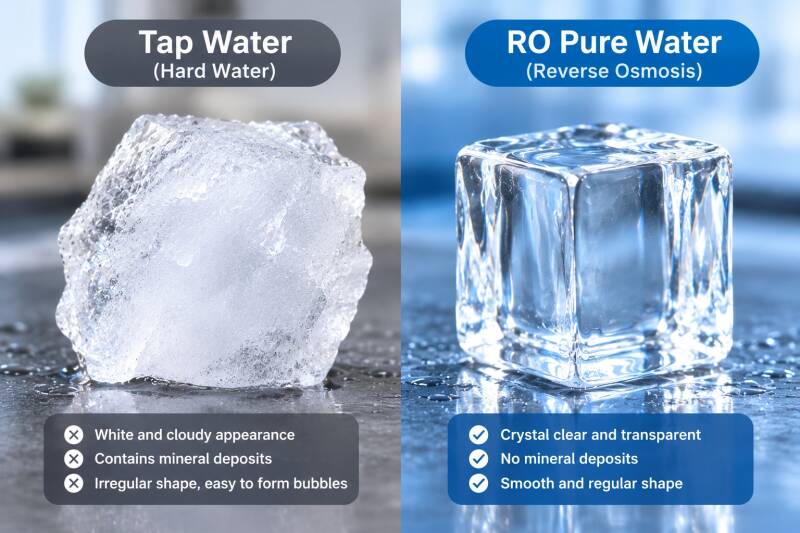
1. The Science: Why Does Tap Water Ice Turn White and Cloudy? When water freezes in your refrigerator, it freezes from the outside in. As liquid water transitions into solid ice crystals, pure H2O molecules bind together first, pushing dissolved mineral ions (calcium, magnesium, silica) and trapped air bubbles inward toward the center.
By the time the core freezes, all those minerals are trapped in a high-density, white core. That cloudy center isn't just ugly—it's composed of concentrated mineral hardness and trapped municipal gases!
2. Where Does That Weird "Freezer Odor" Come From? Have you ever noticed that ice tastes like leftover food or stale plastic? Tap water ice is porous due to all the trapped air micro-bubbles. These microscopic air pockets act like small sponges, absorbing volatile organic odors cycling through your freezer compartment from exposed food items, onion slices, or freezer burn.
3. The Solution: Connecting Reverse Osmosis to Your Refrigerator Reverse Osmosis (RO) forces water through a semi-permeable membrane with pores as small as 0.0001 microns. This removes 95% to 99% of all Total Dissolved Solids (TDS), heavy metals, and chlorine.
-
Pure Crystal Structure: With zero dissolved minerals, RO water freezes uniformly into solid, perfectly transparent ice crystals without a white core.
-
Slower Melting Rate: Dense, mineral-free ice has a higher mass density, meaning it melts much slower and won't dilute your premium drinks or cold brews prematurely.
-
Zero Residue: When an RO ice cube melts in a glass of water, it leaves no floaty white specs or chalky film at the bottom of your glass.
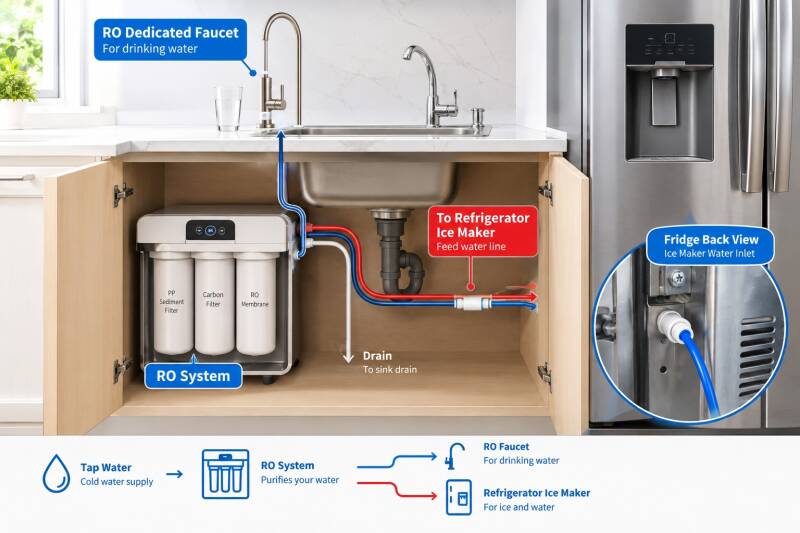
How Aqua Tech Texas Installs Refrigerator RO Feeds: During an under-sink RO installation, our certified technicians run a dedicated 1/4-inch high-pressure line directly to your refrigerator's ice maker and door water dispenser. You get pristine drinking water and luxury ice from a single, compact system.
Call to Action: Elevate your cold drinks today. Contact Aqua Tech Texas to learn how easy it is to link an under-sink RO system to your refrigerator!
Add comment
Comments